
Fitness Goals are easiest to abandon when they’re vague, overly ambitious, or disconnected from how your life actually runs week to week. The fix isn’t more motivation, it’s better goal design: clear targets, realistic timelines, and a plan you can repeat even on busy days.
If you’ve ever gone “all in” for two weeks and then fizzled out, you’re not alone. A lot of people set goals based on the outcome they want, not the process they can sustain. That mismatch creates guilt, restarts, and the feeling that you “just can’t stay consistent,” even though the setup was the real problem.
This guide walks you through a practical way to set goals that fit your schedule, your current fitness level, and your preferences. You’ll get a self-check, a simple planning table, example goals, and a few guardrails to help you stay safe. If you have medical conditions, injuries, or you’re returning after a long break, it’s smart to consult a qualified professional.

Start with your “why,” but make it usable
Most “why” statements sound inspiring and still fail in real life because they don’t tell you what to do on Tuesday at 6:30 p.m. A usable “why” points to a behavior you can repeat, not just a result you hope appears.
Try this quick translation:
- Outcome wish: “I want to lose weight.”
- Usable why: “I want steady energy and fewer aches, so I can keep up with my day.”
- Behavior hint: “I can commit to three 30-minute sessions and two short walks weekly.”
According to the Centers for Disease Control and Prevention (CDC), adults benefit from a mix of aerobic activity and muscle-strengthening activity. You don’t need to memorize guidelines to set goals, but it helps to anchor your plan in a balanced approach instead of only chasing one number on the scale.
Why “unrealistic” goals happen (and how to spot them early)
People rarely choose unrealistic targets because they’re naive. They choose them because they’re impatient, overwhelmed, or comparing themselves to a version of someone else they see online. The most common traps show up in pretty normal situations.
- Timeline fantasy: expecting major changes in a few weeks, then feeling defeated.
- All-or-nothing planning: building a routine that only works in a perfect week.
- Underestimating recovery: adding intensity faster than joints, sleep, and stress can tolerate.
- Ignoring preferences: picking workouts you hate, then calling it a discipline problem.
- Measuring the wrong thing: tracking only weight, when strength, stamina, or consistency are the real wins.
A realistic goal feels slightly challenging and also believable. If you read your goal and your first thought is “There’s no way I can do that with my schedule,” that’s useful information, not failure.
A quick self-check: what kind of goal-setter are you right now?
This section is less about labels and more about selecting the right strategy. Answer honestly, then use the matching approach in the next section.
- If you start strong then stop: your plan likely asks for too much per week, or has no fallback option.
- If you “do everything” but don’t see progress: you may need clearer metrics, better recovery, or more focused training.
- If you rarely start: the goal may be too intimidating, too vague, or not tied to a routine trigger.
- If you’re returning after injury or a long break: you’ll usually need slower ramps and more conservative milestones.
Keep one thought in mind: the best Fitness Goals are not the most impressive, they’re the ones you can repeat for months.
Build Fitness Goals with the “Target + Track + Time + Tolerance” method
You can use SMART goals, and they can work well. But many people still struggle because the goal is “specific” without being “tolerable.” This method keeps it practical.
1) Target: what you’re aiming to improve
- Strength (e.g., squat, push-ups, deadlift variations)
- Cardio capacity (e.g., walk/run duration, cycling distance)
- Body composition (fat loss, muscle gain, waist measurement)
- Performance (pace, reps, mobility range, sport skill)
- Consistency (showing up is a legitimate target)
2) Track: how you’ll measure it without obsessing
Pick one primary metric and one supporting metric. More tracking sounds “serious,” but it often creates noise.
- Primary: workouts completed per week, average daily steps, or a lifting progression
- Supporting: sleep hours, soreness level, mood/energy, or waist measurement
3) Time: choose a timeframe that allows learning
Four to twelve weeks is a reasonable window for many goals because it’s long enough to build a pattern, but short enough to reassess. If you’re new, stressed, or time-crunched, give yourself more runway.
4) Tolerance: the “bad week” test
Ask: “If I sleep poorly, travel, or get slammed at work, can I still do a smaller version of this plan?” If the answer is no, the goal might be more fragile than it looks.
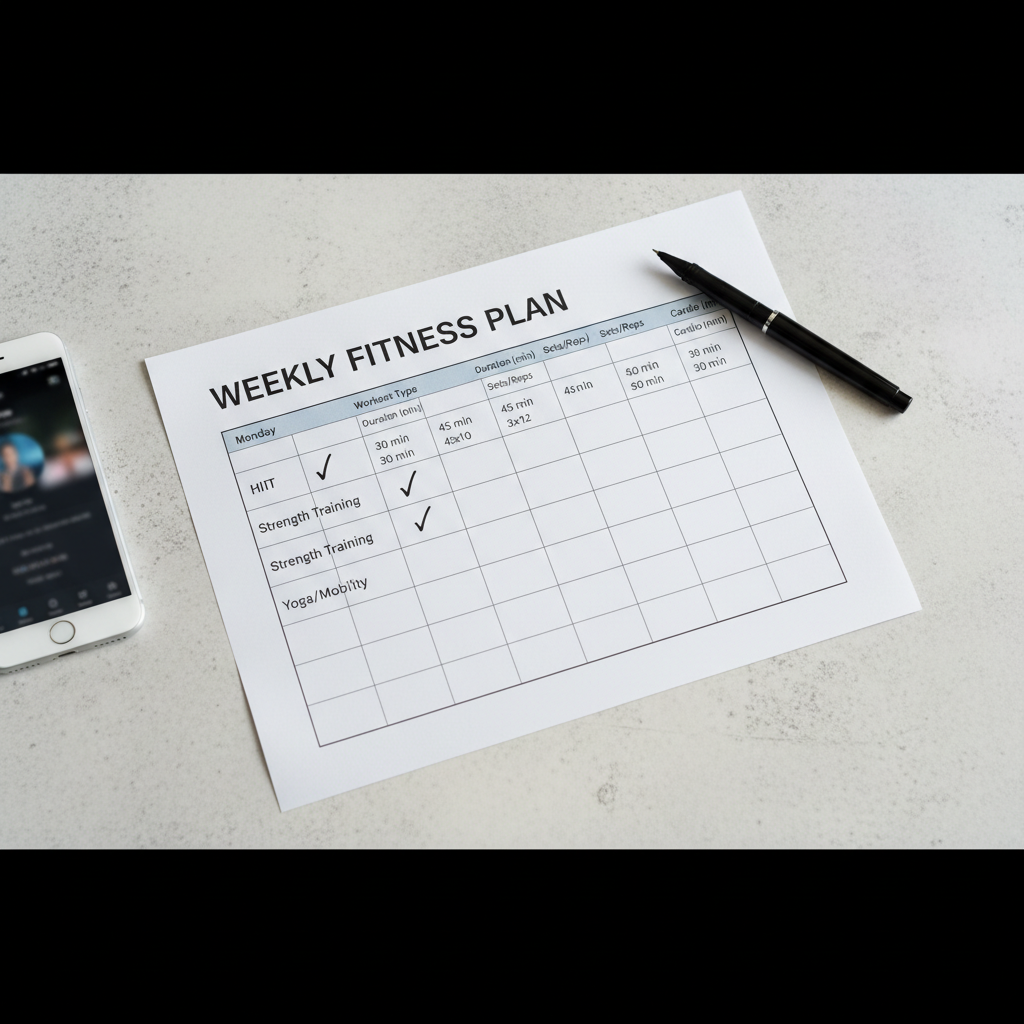
Use this planning table to turn intention into a doable week
A plan becomes realistic when it has a minimum version. That minimum is what protects your progress from life chaos.
| Goal type | Primary metric | Weekly plan (ideal) | Weekly plan (minimum) | Progress check |
|---|---|---|---|---|
| Consistency | Sessions/week | 4 workouts x 45 min | 2 workouts x 20 min | Weekly |
| Strength | Reps or load | 3 lifting days + 1 easy walk | 2 lifting days | Every 2 weeks |
| Cardio | Minutes in zone | 150 min moderate cardio | 60 min total (short bouts) | Weekly |
| Fat loss | Waist + trend weight | 3 strength + steps target | 2 strength + walks after meals | Every 2–4 weeks |
Key point: the minimum plan should feel almost too easy. That’s intentional. Your “ideal week” will happen often enough if the minimum keeps you in the game.
Practical examples you can copy (and adjust)
Below are sample Fitness Goals written in a way that leaves less room for mental negotiation. Customize the numbers to your current level and, if needed, check with a clinician or certified trainer.
- Beginner consistency: “For the next 6 weeks, I’ll complete 3 workouts per week (20–40 minutes). Minimum: 2 workouts if the week gets messy.”
- Strength focus: “In 8 weeks, I’ll increase my dumbbell bench press by 10–20 lb total while keeping form strict, training 3 days/week.”
- Cardio base: “By week 10, I’ll comfortably walk briskly for 45 minutes, 4 days/week, using a pace where I can speak in short sentences.”
- Body composition without obsession: “Over 12 weeks, I’ll hit 8,000 steps/day on average and lift 3 days/week, checking waist measurement monthly.”
- Return after a break: “For 4 weeks, I’ll rebuild the habit with 2 full-body sessions/week and daily 10-minute mobility.”

Execution tips that make realistic goals stick
This is the part people skip because it feels “too basic,” but it’s usually what decides success. The goal can be perfect on paper and still fail without a few practical supports.
- Schedule it like an appointment: pick days and approximate times, not just “3x/week.”
- Use a default workout: one simple session you can do anywhere when decision fatigue hits.
- Track streaks, not perfection: aim for weekly completion, not flawless daily performance.
- Plan your friction: if the gym commute kills you, switch to home workouts or a closer location.
- Keep progression small: add a little volume or intensity at a time so recovery keeps up.
According to the American College of Sports Medicine (ACSM), gradual progression and appropriate recovery matter for reducing injury risk and improving fitness. In plain English, you typically get further by adding less, more consistently.
Common mistakes (that look like “discipline problems”)
Some goal failures aren’t willpower issues, they’re planning errors. If any of these sound familiar, adjust the system before blaming yourself.
- Only setting outcome goals: “Lose 20 pounds” without defining weekly behaviors.
- Changing the plan every week: variety is fine, but constant resets make progress hard to measure.
- Using punishment workouts: doubling cardio after a meal usually backfires emotionally and physically.
- Ignoring pain signals: sharp pain, numbness, dizziness, or chest discomfort should be taken seriously.
- Copying advanced programs: if you’re new, high volume can outpace recovery fast.
If you notice fatigue piling up, motivation dropping, or soreness that lingers, it may be a sign your goal pace exceeds your tolerance. A deload week, more sleep, or a simpler routine often fixes more than people expect.
When it’s worth getting professional help
There’s a time to DIY and a time to bring in support. You don’t need a coach for everything, but some situations are easier and safer with guidance.
- Chronic pain, recent injury, or surgery history
- Medical conditions or medications that affect exercise tolerance
- Repeated stalls despite consistent training and reasonable recovery
- Confusion around form, especially for loaded lifts
- History of disordered eating, or goals that trigger unhealthy behaviors
If anything feels off physically, consulting a physician or qualified clinician is a sensible move. If your main challenge is programming and consistency, a certified personal trainer can help you set targets that fit your life and adjust them without guesswork.
Conclusion: realistic goals are the ones you can repeat
Realistic Fitness Goals don’t feel like a personality makeover, they feel like a plan you can keep even when your week goes sideways. Build your target around a usable “why,” choose a small set of metrics, give yourself a timeframe that allows learning, and protect the plan with a minimum version.
Action steps: write one goal using “Target + Track + Time + Tolerance,” then schedule your next two workouts on your calendar. If you do nothing else this week, do the minimum plan and keep the streak alive.
Key takeaways
- Design beats motivation: goals fail more from bad structure than lack of willpower.
- Minimum plans matter: they keep progress moving through busy weeks.
- Track less, better: one primary metric plus one supporting metric is usually enough.
- Progress slowly: recovery and consistency often outperform intensity spikes.
FAQ
How do I know if my fitness goal is realistic for my schedule?
If you can’t describe a minimum version you’d still do during a stressful week, the plan probably asks for too much. Scale frequency or session length until it passes the “bad week” test.
Should Fitness Goals focus on weight loss or performance?
It depends on what you value and what’s healthy for you. Many people do better with performance or consistency goals because they’re more controllable, while body changes often follow as a side effect.
How often should I change my goal?
Give a plan at least 4–8 weeks unless something clearly isn’t working or you’re dealing with pain or excessive fatigue. Small adjustments beat full resets.
What if I miss workouts, do I restart the whole plan?
Usually no. Treat misses as normal variance, return to the minimum plan, and focus on weekly completion rather than “perfect streaks.” Restarting from zero too often is what breaks momentum.
Is it okay to set a big long-term goal?
Yes, big goals can be motivating, but they work best when you pair them with short cycles you can measure. Think of the long-term goal as direction, and the 4–12 week plan as the engine.
How do I set goals if I’m a beginner and don’t know my numbers?
Start with consistency and form-focused targets for the first month. Once you have a baseline, shift to measurable goals like reps, time, or session count.
When should I worry that my goal is unsafe?
If you feel sharp pain, dizziness, chest discomfort, numbness, or symptoms that concern you, stop and consider medical advice. For non-urgent issues like recurring joint irritation, a trainer or physical therapist can help you modify technique and volume.
If you’re trying to set Fitness Goals but keep getting stuck between “too easy” and “way too much,” it may help to get a simple template and an outside set of eyes to sanity-check your plan, especially if you’re returning after a break or juggling a tight schedule.