
A fitness workout plan works best when it removes daily guesswork, tells you what to do next, and still leaves room for real life.
If you have ever bounced between random YouTube workouts, skipped days because you “didn’t have a plan,” or trained hard for two weeks then disappeared for two months, you are not lazy, you are under-structured. A weekly framework fixes that.
This guide gives you a practical week you can repeat, plus “swap options” for different fitness levels, limited equipment, and common constraints like busy schedules or cranky knees. You will also get a quick self-check, a table you can screenshot, and a few guardrails so you do not overdo it.
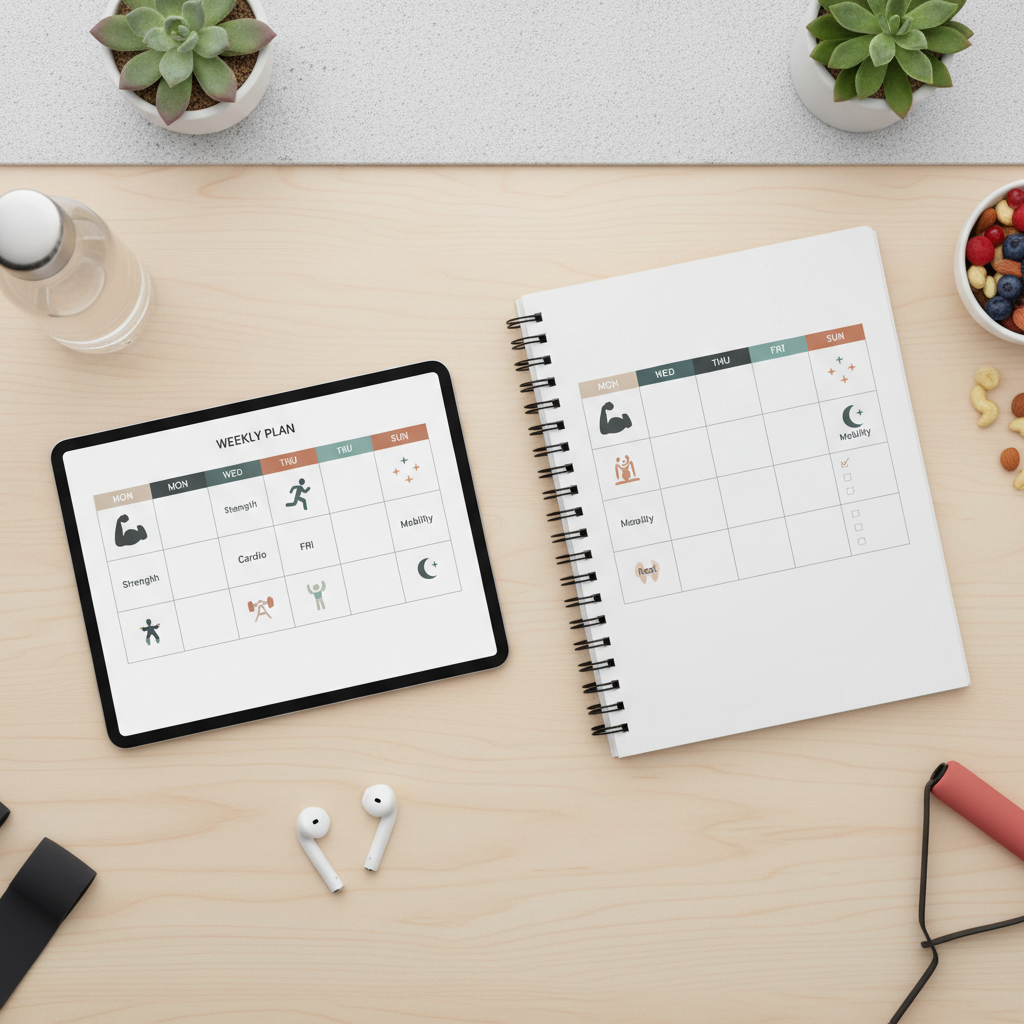
What a good weekly plan actually does (and what it avoids)
Most people do not need more intensity, they need a better rhythm. A workable week usually balances three things: progressive strength, cardio you can recover from, and enough rest to repeat the week.
- It reduces decision fatigue: you know the day’s focus before you walk in.
- It spreads stress: hard days are separated so soreness and fatigue do not pile up.
- It supports consistency: the plan still works when you miss one session.
- It avoids “all gas, no brakes”: too many HIIT days tends to backfire for many people.
According to CDC, adults generally benefit from both aerobic activity and muscle-strengthening activity across the week, which is a helpful anchor when you are deciding what to prioritize.
Quick self-check: choose your level before you choose your workouts
This part sounds basic, but it prevents a lot of frustration. Pick the level that matches your current reality, not your best month two years ago.
Beginner (start here if any are true)
- You have not trained consistently in the past 8–12 weeks.
- Basic movements feel awkward: squat, hinge, push-up, row.
- Soreness lasts more than 48 hours after most sessions.
Intermediate
- You can train 3–5 days per week most weeks.
- You know your working weights and can add reps or load gradually.
- Form is mostly stable even when you are tired.
Advanced
- You recover well from higher volume, and you track performance.
- You have clear goals: strength numbers, race pace, physique blocks.
- You can adjust training based on fatigue without derailing.
If you have pain, dizziness, or a medical condition, training may still be possible, but it is smart to consult a qualified healthcare professional or a certified coach who can tailor modifications.
The weekly workout table (repeatable template)
Here is a simple weekly structure that fits most goals: fat loss, general fitness, strength, and “look/feel better” training. You will notice it is not complicated, on purpose.
| Day | Focus | Beginner | Intermediate | Advanced |
|---|---|---|---|---|
| Mon | Strength A (full body) | 30–40 min | 45–60 min | 60–75 min |
| Tue | Cardio (easy/zone 2) | 20–30 min | 30–45 min | 40–60 min |
| Wed | Strength B (full body) | 30–40 min | 45–60 min | 60–75 min |
| Thu | Mobility + walk | 15–25 min | 20–30 min | 20–40 min |
| Fri | Strength C (full body) | 30–40 min | 45–60 min | 60–75 min |
| Sat | Conditioning or sport | Optional: light | Moderate | Hard (if recovered) |
| Sun | Rest | Rest | Rest | Rest or very easy |
Key point: if your week is chaotic, keep Mon/Wed/Fri strength and let the rest flex. That alone covers a lot of ground.
Strength sessions: what to do on A/B/C days
The easiest way to build a fitness workout plan you can repeat is to center it around movement patterns, not a long list of exercises. Each strength day hits: squat pattern, hinge pattern, upper push, upper pull, plus core.

Strength A (squat emphasis)
- Squat: goblet squat or back squat
- Upper push: incline push-up or bench press
- Upper pull: one-arm dumbbell row or lat pulldown
- Accessory: split squat or leg press
- Core: plank variations
Beginner sets/reps: 2–3 sets of 8–12 per move, stop with 2–3 reps “in the tank.”
Intermediate/advanced: 3–5 sets, use a mix of 5–8 reps (main lift) and 8–15 reps (assistance).
Strength B (hinge emphasis)
- Hinge: Romanian deadlift, trap-bar deadlift, or hip hinge with dumbbells
- Upper push: overhead press or dumbbell press
- Upper pull: assisted pull-up or cable row
- Accessory: hip thrust or hamstring curl
- Core: dead bug or Pallof press
If your lower back gets cranky, many people do better swapping heavy deadlifts for a lighter hinge plus hip thrusts, especially when stress and sleep are not great.
Strength C (balanced + single-leg)
- Single-leg: reverse lunge or step-up
- Upper push: dips (assisted) or push-ups
- Upper pull: chest-supported row or band row
- Carry: farmer carry or suitcase carry
- Core: side plank or cable chops
Progression rule: when you hit the top of your rep range with solid form, add a small amount of weight next session, or add 1–2 reps per set if weight jumps are too big.
Cardio and conditioning: keep it supportive, not punishing
Cardio fits into a weekly plan in two different roles: build your base (easy cardio) and sharpen capacity (harder intervals). Many routines fail because every cardio day becomes a suffer-fest, then recovery and motivation collapse.
- Easy/zone 2 idea: brisk incline walk, cycling, easy jog where you can talk in short sentences.
- Intervals idea: 6–10 rounds of 30 seconds hard, 90 seconds easy, only if you recover well.
- Low-impact swaps: rower, bike, swimming, elliptical.
According to American Heart Association, mixing regular aerobic activity with strength work supports overall cardiovascular health, which is one reason this plan keeps cardio consistent but not extreme.
Practical execution: warm-ups, time options, and “missed day” fixes
This is the part that makes a fitness workout plan feel easy instead of fragile.
A simple warm-up you will actually do (6–8 minutes)
- 2 minutes easy cardio to raise temperature
- 2 mobility moves: hips + shoulders
- 2 ramp-up sets for your first lift using lighter weight
If you only have 30 minutes
- Pick 3 moves: one lower-body, one push, one pull
- Do 3 rounds, controlled pace, stop before form breaks
- Optional: 5-minute finisher walk or bike
If you miss a day (don’t “make up” everything)
- Missed cardio: add a 20–30 minute walk later in the week.
- Missed strength: slide the next strength day forward, keep at least one rest day.
- Missed two sessions: restart the week as written, do not cram three hard days in a row.
Common mistakes and safety notes (so you keep momentum)
- Going too hard on week one: soreness is not proof of a good plan, it is often proof of too much too soon.
- Changing exercises every session: variety feels fun, but progress usually needs repetition long enough to measure.
- Ignoring recovery: if sleep and stress are rough, reduce volume before you reduce consistency.
- Chasing perfect macros while skipping training: many people get better results focusing on workouts first, then tightening nutrition.
If you feel sharp pain, numbness, chest discomfort, or unusual shortness of breath, stop training and consider seeking medical advice. Online plans cannot assess your individual risk factors.
Conclusion: make the plan boring enough to work
A weekly structure wins because it is repeatable. Keep three strength days, add easy cardio you can recover from, protect one real rest day, then progress in small steps.
If you want an easy starting action, pick your level, screenshot the weekly table, then run it for two weeks without “improving” it. After that, adjust one variable at a time, usually volume or intensity, not everything at once.
Key takeaways:
- Consistency beats novelty for most goals.
- Strength anchors the week, cardio supports it.
- Small progression is safer and more sustainable than big jumps.
FAQ
What is the best weekly fitness workout plan for beginners?
Most beginners do well with 3 full-body strength days plus 1–2 easy cardio days. The goal is learning movements, building tolerance, and leaving the gym feeling like you could do it again tomorrow.
How long should I follow the same plan before switching?
Often 6–12 weeks is enough to see progress and learn what is working. You can rotate exercises sooner if something hurts or you cannot load it safely, but constant switching makes progress harder to track.
Can I lose weight with this fitness workout plan?
It can support weight loss because strength training helps preserve muscle while you are in a calorie deficit, and cardio adds energy expenditure. Results still depend on nutrition, sleep, and consistency, so think of the plan as the training backbone.
Is it okay to do cardio and strength on the same day?
Yes for many people, especially if time is tight. A common approach is strength first, then 10–20 minutes easy cardio. If performance tanks or recovery worsens, separate them or keep cardio easier.
What if I only can work out 2 days a week?
Do two full-body strength sessions and add walking when you can. Many people are surprised how far two good sessions go when they are consistent and progressively a bit harder over time.
How do I know if I am overtraining?
Clues include persistent soreness, declining performance, irritability, sleep disruption, and elevated fatigue that does not improve with a couple easier days. If that pattern shows up, reduce volume and consider professional guidance.
Do I need supplements to follow this plan?
Not usually. Many people prioritize protein intake, hydration, and sleep first, then consider basics like creatine or protein powder if it fits their diet and they tolerate it well, ideally after consulting a clinician if they have medical concerns.
If you are trying to build a fitness workout plan around a tight schedule, limited equipment, or specific goals like a first pull-up or a faster 5K, a coach or structured program can save time by picking the right progressions and keeping you accountable without turning training into a second job.