
Bodyweight workout routines are the fastest way to train your whole body when time, space, or equipment feels like the real obstacle, not motivation.
If you’ve ever Googled a “full body routine” and ended up with 40 random moves, no rest guidance, and no idea how to progress, you’re not alone. Most plans fail because they skip the boring-but-important parts: structure, intent, and an easy way to measure improvement.
This guide gives you a simple full-body session you can repeat 2–4 times per week, plus alternatives for beginners, a progression plan, and a quick self-check so you know if you’re actually training “full body” or just doing a lot of squats and push-ups.
What a “full-body” bodyweight session should cover
A well-built full-body session is less about doing every exercise you know, more about covering key movement patterns so muscles and joints get balanced work.
- Squat pattern: knees and hips bend together (e.g., squats, split squats).
- Hinge pattern: hips move back with a flatter torso (e.g., hip hinge good mornings, glute bridge variations).
- Push: horizontal or vertical pressing (e.g., push-ups, pike push-ups).
- Pull: rows or pull-ups if you have a bar, otherwise isometrics and towel rows.
- Core + carry/bracing: anti-extension/anti-rotation (e.g., dead bug, plank, side plank).
According to the American Council on Exercise (ACE), focusing on proper technique and progressive overload (gradually increasing the challenge) is central to long-term results. With bodyweight training, overload usually comes from leverage changes, tempo, range of motion, and density, not just adding plates.
Quick self-check: is your bodyweight routine actually balanced?
Use this checklist before you copy a routine from social media. If you miss two or more items, you’ll usually feel “worked,” but progress stalls fast.
- You have at least one push and one pull movement.
- You train both squat and hinge patterns (not just squat variations).
- You can describe the progression (harder variation, slower tempo, more reps, shorter rest).
- You stop most sets with 1–3 reps in reserve (not daily maxing out).
- You can repeat the session next week without your joints feeling “cranky.”
If pulling is the missing piece, that’s common at home. You can still build a legit bodyweight workout plan, but you’ll want to be intentional with rows, holds, and shoulder-friendly volume.
The full-body bodyweight workout routine (no equipment)
This is the core session. Run it as a circuit or as straight sets. Pick the version that helps you keep clean form.
Warm-up (5–8 minutes)
- 30–45 seconds: marching in place or light jumping jacks
- 6–8 reps per side: world’s greatest stretch (slow and controlled)
- 8–10 reps: hip hinge drill (hands on hips, push hips back)
- 8–12 reps: scapular push-ups (shoulder blades move, elbows mostly straight)
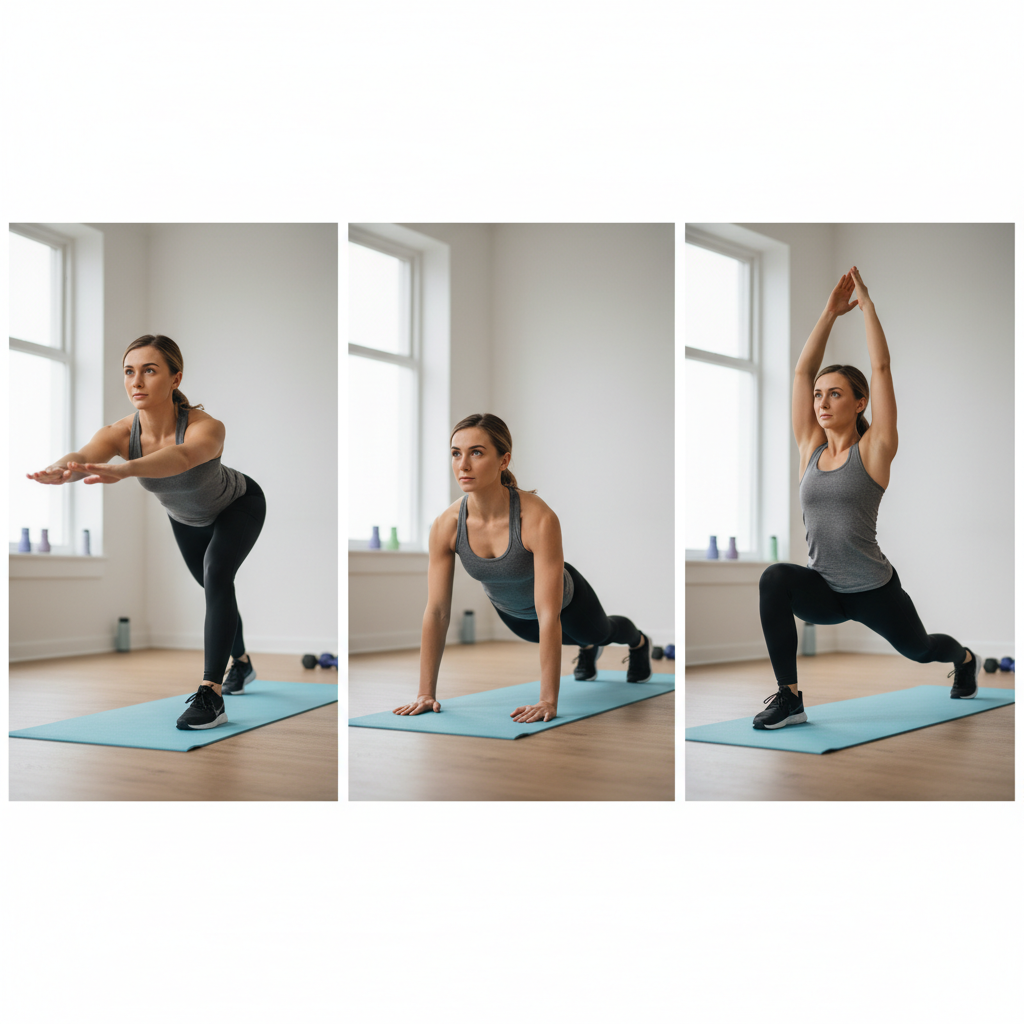
Main workout (30–40 minutes)
Option A: Straight sets (easier to track)
- Split squat: 3 sets of 8–12 per side, rest 60–90s
- Push-up (incline/knee/standard): 3 sets of 6–15, rest 60–90s
- Single-leg glute bridge: 3 sets of 8–15 per side, rest 45–75s
- Prone Y-T-W raises (upper-back control): 2–3 sets of 6–10 each letter, rest 45–60s
- Side plank: 2–3 sets of 20–45s per side, rest 30–45s
Option B: Circuit (good when time is tight)
- Do 3–5 rounds
- 40 seconds work, 20 seconds rest between moves
- Rest 90 seconds between rounds
In either version, choose a difficulty where the last few reps slow down, but your form stays predictable. That’s where a bodyweight workout tends to create results without turning every session into survival mode.
If you have basic equipment, here are high-value upgrades
You don’t need gear, but a couple items can solve the “no pulling” problem and make progression smoother.
- Doorway pull-up bar: swap Y-T-W raises for assisted pull-ups or negatives.
- Suspension trainer or rings: adds rows, face pulls, hamstring curls.
- Mini band: improves glute activation and makes warm-ups more joint-friendly.
According to the National Strength and Conditioning Association (NSCA), training programs benefit from progressive overload and appropriate exercise selection. Equipment mainly helps you keep overload going once easy variations stop being challenging.
Progression plan: how to keep improving for 6–8 weeks
Most people don’t fail because of effort, they fail because they repeat the same version at the same pace with the same rest, then wonder why nothing changes.
Pick one progression lever per block
- Reps: add 1 rep per set until you hit the top of the range.
- Tempo: add a 3-second lowering phase on squats and push-ups.
- Range of motion: deeper split squat, deficit push-up on books (stable surface).
- Leverage: decline push-up, shrimp squat progression, longer plank lever.
- Rest: shorten rest slightly, but only if form stays clean.
Simple 8-week example (repeatable)
| Weeks | Focus | What you change |
|---|---|---|
| 1–2 | Technique + consistency | Stay 2–3 reps shy of failure, learn variations |
| 3–4 | Rep progression | Add 1–2 reps per set where possible |
| 5–6 | Tempo progression | Use 3-sec lowering on main lifts |
| 7 | Harder variation | Move up one step (e.g., incline push-up → standard) |
| 8 | Deload | Cut sets by ~30–40%, keep form crisp |
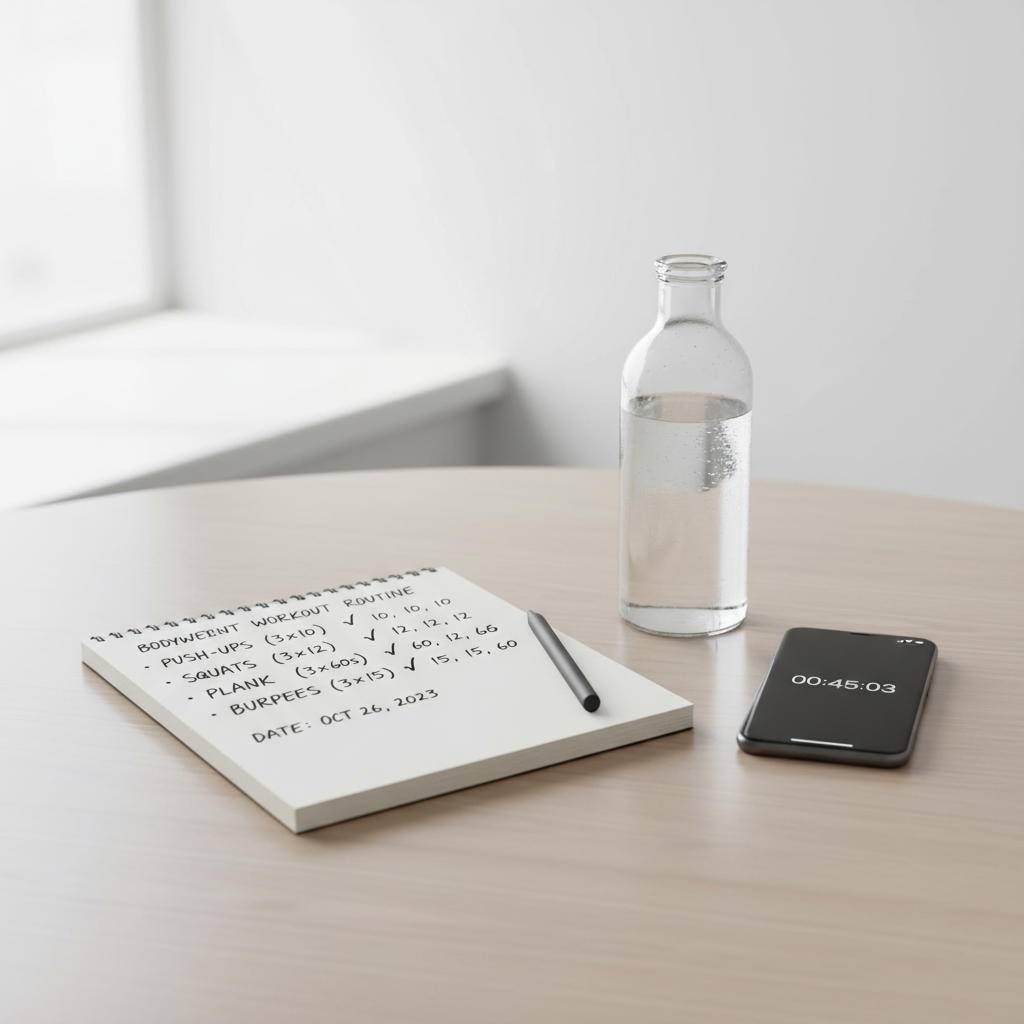
Practical weekly schedules (2, 3, or 4 days)
Your schedule matters more than the perfect exercise list. Pick the option you can repeat for a month without negotiating with yourself.
2 days/week
- Mon: Full-body routine
- Thu or Fri: Full-body routine
3 days/week
- Mon/Wed/Fri: Full-body routine
- Keep one day slightly lighter by cutting 1 set from each move
4 days/week
- Mon/Thu: Full-body (strength emphasis, straight sets)
- Tue/Fri: Full-body (density emphasis, circuit style)
If recovery feels rough, don’t assume you “need more grit.” It often means sleep, nutrition, stress, or exercise selection needs a tweak.
Form cues and safety notes that prevent most issues
Bodyweight training looks safe, but elbows, shoulders, knees can still get irritated when volume climbs. These cues usually solve the common complaints.
- Push-ups: keep ribs down, squeeze glutes, hands under shoulders, stop before your shoulders roll forward.
- Split squats: slight forward torso lean, front foot planted, drive through mid-foot.
- Glute bridge: exhale and brace, don’t over-arch your low back at the top.
- Planks: think “long spine,” not “high hips,” stop when your lower back takes over.
According to the Centers for Disease Control and Prevention (CDC), muscle-strengthening activities are recommended as part of weekly physical activity for general health. If you have a medical condition, recent injury, or pain that changes your movement, it’s smart to consult a qualified healthcare professional before pushing intensity.
Key takeaways (so you can act today)
- A full-body plan works when it covers squat, hinge, push, pull, and core, even with minimal equipment.
- Progress comes from one clear lever at a time: reps, tempo, range, leverage, or rest.
- Consistency beats novelty; repeating the same session for 6–8 weeks is often the point.
If you want a clean starting point, run the routine 3 days per week for two weeks, track reps and rest, then adjust difficulty once you hit the top of each rep range with solid form.
FAQ
Is a bodyweight workout enough to build muscle?
In many cases, yes, especially for beginners and intermediates. The key is getting close to technical failure with good form and using progressions once standard reps feel easy.
How long should a full-body routine take at home?
Most sessions land around 30–45 minutes including warm-up. If you consistently go past an hour, the routine may be too long or rest times may be drifting.
What if I can’t do a single push-up yet?
Start with incline push-ups on a counter or sturdy table, then gradually lower the incline. Knee push-ups can help, but incline versions often transfer better to standard reps.
How do I train “pull” muscles with no equipment?
You can use prone Y-T-W raises and isometric towel rows against a door handle, but progress is limited. If back strength is a priority, a doorway bar or rings usually provide the biggest payoff.
Should I do this routine every day?
Usually not. Full-body sessions need recovery to improve. Many people do best with 2–4 days per week, then light walking or mobility on other days.
How do I know if I’m working hard enough?
A practical rule: end most sets with 1–3 reps left in the tank while keeping form stable. If your reps look identical from start to finish, the variation may be too easy.
Can I add cardio without ruining results?
Often, yes. Keep cardio easy to moderate on non-lifting days, and watch for recovery signals like sleep quality and persistent soreness.
If you’re trying to build a bodyweight workout habit but keep getting stuck on exercise selection, progression, or how to fit sessions into a messy week, it may help to follow a simple template like this for 6–8 weeks and only change one variable at a time.